Wagering Tutorial
If you've taken the time to review the racing form and you've made an informed judgement about which horse or horses you think will perform the best, the next step is to understand the betting options so that you can decide how you want to participate among the many options available.
How/Where to bet
There are three ways to bet on horse racing, 1) at the track, 2) at an off-track betting location (OTB) or 3) through an advance deposit wagering company (online/by phone). If you are at the track just go up to any betting window and they will not only take bets for the track you are at, but usually also for races at other tracks just like an OTB would. If you are at an OTB you can simply place a bet at one of their betting windows and it works just the same as if you were at the track. Click here for a list of all the OTB locations in Illinois. The last option, online wagering, is a fairly new development. It was approved by the Illinois legislature a few years ago and allows for Illinois residents to make deposits with approved vendors and then to place wagers with those vendors either online or by telephone. Click here to see more information from the Illinois Racing Board about online wagering. I have an account with Twin Spires, they are owned by the same group that owns Churchill Downs and Arlington Park, and I found it very easy to use and I imagine the others are as well.
Win, Place, Show
Let's start with the basics, placing a bet on a horse to win the race. The most common bet is betting on a horse to win the race. Leading up to the race the race board will feature the live odds for each horse for a win bet. As more and more wagers are accepted the odds on a given horse will go up or down depending on the wagering. It's important to note that this process is a little bit different than what some gamblers are used to when they place prop bets or futures bets on other sporting events in Las Vegas.
In a Las Vegas prop/future bet the Vegas oddsmakers offer a line and you have the opportunity to lock in your wager at that price. For example, let's say you are in a Las Vegas sportsbook before the start of the NFL season and the odds on your favorite team winning the Super Bowl that year are 20-1 and you place $100 on it. If your team goes on to win the Super Bowl that season you stand to win $2,000 (plus get your $100 back) and you are locked in at that price. If your team finishes the regular season undefeated then by the time the playoffs start the odds on that team winning the Super Bowl may be as low as 2-1. However even though the odds have changed your potential payout doesn't change, you were locked in at that price at the time you made the wager.
However in horse racing the wagering works differently. When you make a bet on a horse to win what you are doing is buying a share of the winners pool. The payout for this kind of bet works a lot like a payout in the lottery. In the lottery the lottery company gathers all of the money bet on the lottery, they take out the cut that goes to the lottery system for running the lottery and the rest is put in the prize pool to be shared by the winners. The prize pools in horse racing work the same way, the racetrack will take all of the money bet on horses to win, they take out their cut and the rest goes into the prize pool to be shared by the winners. If you place a bet on a horse to win you are buying a share of that win pool and the group of people with winning tickets all share the win pool, whatever that total may be.
So when you are looking at the big board to see the odds on the horses these odds are simply a guide to give you an idea of what the payout will be based on current betting. The closer you are to race time, the more accurate the odds will be. If the payout value of your wager is a key component in your decision making process then it makes sense to wait until closer to the race time to make your wager, although you run the risk of being stuck in line when the race starts and not being able to get your bet in on time.
HOW TO MAKE A WIN BET: you need to know a) the name of the track where the race you want to bet on is being held, b) the race number, c) the horse number and d) the amount of the wager. Let's say you want to bet $2 on the #4 horse to win in the third race at Arlington you would tell the teller at the window "for the 3rd race at Arlington I would like two dollars to win on the number 4."
In order to win your "Win" bet the horse you bet on has to finish first. You can also bet on a horse to finish 2nd or better (Place) and you can bet on a horse to finish 3rd or better (Show). If you bet on a horse to Show you will collect if it finishes first, second or third, however the payout will be lower than if you had bet it to win and it won. If you like the chances of a particular horse but just aren't quite certain that it has what it takes to win this is another option to try to collect money with a lower risk/lower reward wager.
HOW TO MAKE A PLACE/SHOW BET: you need to know a) the name of the track where the race you want to bet on is being held, b) the race number, c) the horse number and d) the amount of the wager. Let's say you want to bet $2 on the #4 horse to Show in the third race at Arlington you would tell the teller at the window "for the 3rd race at Arlington I would like two dollars to Show on the number 4."
Exotics - Exacta, Trifecta, Superfecta
Let's say that not only are you confident that you know which horse is going to win, you also think you know which horse is going to finish 2nd, 3rd, 4th, etc. that's where these wagers come in. To win an Exacta bet you need to correctly predict the top 2 finishing horses in the correct order. To win a Trifecta bet you need to correctly predict the top 3 finishing horses in the correct order and to win a Superfecta bet you need to correctly predict the top 4 finishing horses in the correct order. These bets have a higher degree of difficulty and often have a lower minimum bet than the standard $2, you can usually find out which types of exotic wagers will be accepted and their minimum wagering amount on the racing form in the section that shows the race information. It's common to see a $0.50 minimum for trifecta bets and $0.10 for superfecta bets.
In order to win an exacta/trifecta/superfecta you have to pick the horses in the correct order. However many people would like to bet their preferred horses in any order. You can do that by "boxing" the horses. It's important to note that when you "box" the horses what you're really doing is making a bet for every possible outcome so you are placing many bets, not just one bet. Let's say that you want to bet an exacta for your two favorite horses (horse A & horse B) and because you want to bet that they finish in either order you want a $2 exacta-box. This bet will cost you $4 because you are betting on an A-B finish and a B-A finish. For a trifecta there are actually 6 possible outcomes (A-B-C, A-C-B, B-A-C, B-C-A, C-A-B, C-B-A) so a $2 trifecta box will cost you $12. A superfecta has 24 possible outcomes so a $2 superfecta box would cost you $48 dollars.
The payouts for these bets are usually not known until the race is over. Because there are so many possible permutations it's impossible to list them all in real time. They also depend on the size of the prize pool and the number of winners. The payouts also do not necessarily correlate to the win odds that you will see listed on the tote board. Generally though if the top finishing horses are the favorites the payout will be low because picking the favorites will be a common bet and if the top finishing horses are longshots the payouts will be higher because picking longshots will be a less common bet. The number of horses in the race will also have an effect on the payouts, it's easier to pick the top few horses in a 6 horse race than it is in a 12 horse race.
On an average Saturday a successful $2 exacta will pay about $10-$80, a successful $2 trifecta will pay about $50-$500 and a successful $2 superfecta will pay about $75-$3,000. The payouts can be more/less than that but it's a reasonable range. However on big races (especially with big fields) the payouts can be enormous. The Kentucky Derby fields 20 horses so it's not only difficult to pick the winner but it's very difficult to correctly predict the top few. If you do the payouts can be quite high. In 2009 the Kentucky Derby was won by Mine That Bird, a 50-1 longshot. The $2 exacta paid $2,704.80, the $2 trifecta paid $41,500.60 and the $2 superfecta paid a whopping $557,006.40.
HOW TO MAKE AN EXACTA/TRIFECTA/SUPERFECTA BET: you need to know a) the name of the track where the race you want to bet on is being held, b) the race number, c) the horse numbers and d) the amount of the wager. Let's say you want to make a $2 trifecta box wager (correctly guessing the first three horses in any order) on the #3, #4 and #7 horses in the third race at Arlington you would tell the teller at the window "for the 3rd race at Arlington I would like a $2 trifecta-box on the 3-4-7." This bet would cost you $12.
Double, Pick 3, Pick 4, Pick 5, Pick 6
Let's say you only want to pick the winners of races and you don't want to get mixed up in picking who comes in 2nd, 3rd, 4th, etc. but you want to raise the risk/reward with your winners picks these types of bets allow you to wager on correctly picking the winner in consecutive races. To win the double you would need to correctly predict the winner of the current race as well as the next race at the same track. For the pick 3 you would have to correctly select the winner of the current race as well as the next two races ... and so on. These bets will allow you to increase your risk/reward just by picking the winners of races.
For the pick 5 and pick 6 it's common to have the prize pools carry over if there are no winners. Sometimes you will see the pools get quite large after significant carryovers.
How to read the Payout board
Once the race is over if you think that you've won a bet you have to wait until the race is "official". This usually happens a few minutes after the finish of the race. Once the race is official you can take your winning ticket to the betting window to claim your winnings. Also the track will post the winning payouts on the board. This is what the board looked like at the end of the 2011 Kentucky Derby:
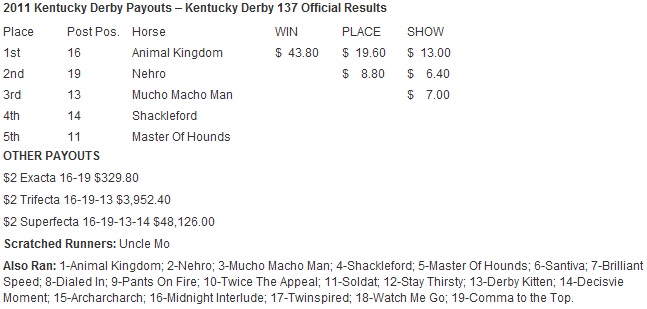
The payout amounts are based on a standard $2 bet. In this case if you bet $2 to win on Animal Kingdom it paid $43.80. He paid $19.60 to Place and $13.00 to show. If you bet a different amount than $2 then you should adjust your winnings accordingly. As you can see Nehro only paid for Place and Show bets while Mucho Macho Man only paid for Show bets.